
A Detailed Look: Berry and Minor set official visits as the Wolfpack weighs a 2-to-4 player class
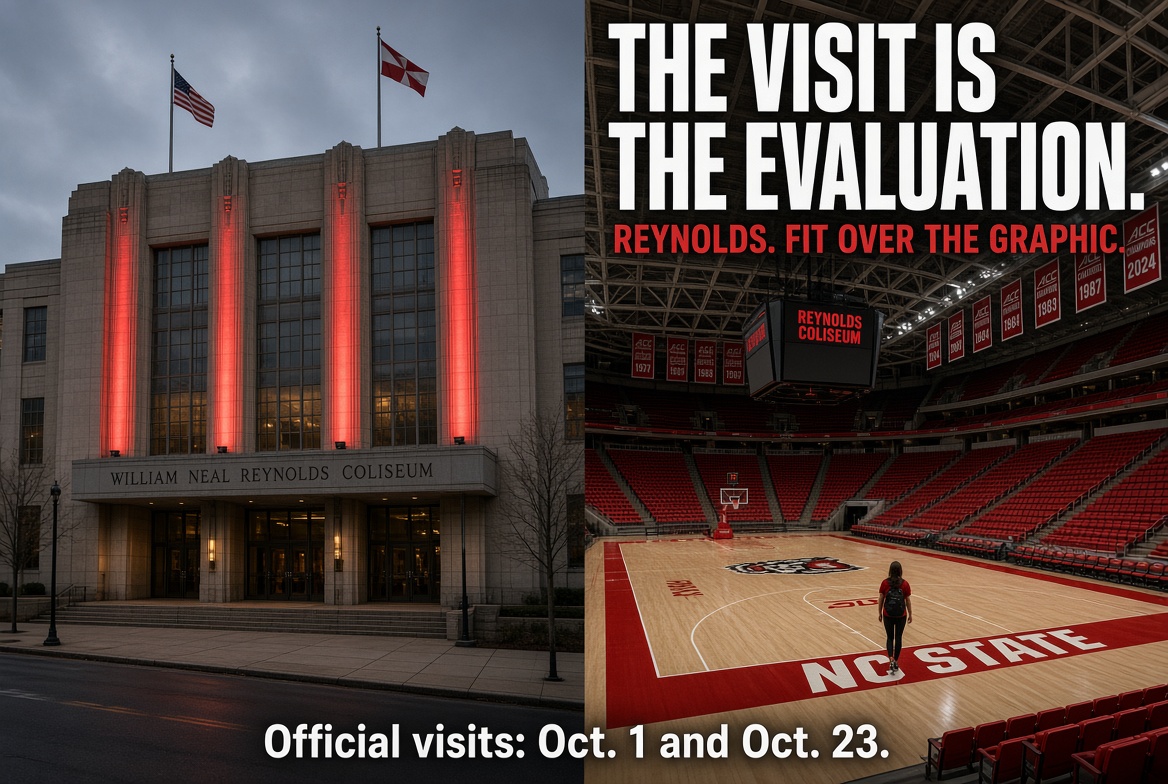
NC State women’s basketball has spent much of 2026 operating in characteristic Wes Moore fashion: quietly, selectively, and with an eye on roster continuity rather than volume. That approach makes the two official visits now on the calendar for the Class of 2027 more notable than they first appear. Four-star combo guards Chance Berry and De’Andra Minor have both placed the Wolfpack among a tight group of finalists and scheduled official visits to Raleigh. Berry is slated for Oct. 23. Minor arrives first, on Oct. 1. For a program that has not yet added a high-school commitment in the 2027 cycle, these visits are the clearest public signal yet that Moore’s staff is still hunting high-upside perimeter talent.
The next questions hanging over the cycle are whether NC State can also close on five-star wing Qandace Samuels, how a late offer to Justice Brown-Jones fits if Samuels does or does not come, which other known offers still have life, whether the staff still wants a true post such as Abuna Ruop, and how many 2027 high-school spots open once seniors decide whether to use the 5-in-5 rule.
That last piece matters more than the old one-or-two-player assumption. The 5-in-5 rule makes attrition tangible. Some seniors might stay. Some might leave. If even two or three eligible veterans walk, a 2-to-4 player high-school class becomes the realistic range, not a stretch. Moore still likes a compact roster. He does not have to treat 2027 as a one-scholarship cycle.
Moore’s recruiting pattern is the hidden structure under all of that. Rankings are imperfect, but his wheelhouse has long been the 30-to-60 national range: productive, versatile players who fit the program rather than consensus top-10 names. He does land top-15 talent sometimes. Zoe Brooks and Zamareya Jones were that kind of swing. The 2027 board looks like the same mix. Berry sits around ESPN’s No. 50. Minor is higher, listed as No. 44 on the service, but still in Moore’s usual strike zone than to a UConn or South Carolina board. Samuels is the Brooks/Jones exception: a true top-15 wing. If Raleigh is doing what it usually does, Berry and Minor are the liveliest bets. If it is swinging above its typical range, Samuels is the tell.
Chance Berry: Canadian scoring guard now based in Florida
Berry, a 5’11” combo guard, moved from Royal Crown Academy in Toronto to DME Academy in Daytona Beach this summer for her senior year. ESPN ranks her No. 50 nationally and sixth in Florida. She is a four-star prospect with international experience: she played for Canada at the FIBA U16 Americas Championship and the FIBA U17 World Cup, averaging six points per game at the latter. In 2025 she started every game for the All Knighters in Overtime Select as the club won the title.
On Sept. 2 she trimmed her list to eight schools: Arizona, Arizona State, NC State, Penn State, Syracuse, Texas Tech, West Virginia and UCF. The Wolfpack made the cut and locked in the late-October official visit. Berry has said she plans to sign during the early period that opens Nov. 11. That timeline gives NC State a defined window after her campus trip to close.
Berry’s game is built around scoring and size for a guard. She can create off the bounce, finish through contact, and has shown the ability to fill a stat sheet. For NC State, she would add another versatile piece on the perimeter next to returning players and the incoming 2026 class of Kamora Pruitt and Annsley Trivette. She is also the cleanest example of Moore’s 30-60 comfort zone on this board.
De’Andra Minor: Oklahoma’s top 2027 prospect
Minor, listed at 6’0″ or 6’1″ depending on the source, is the higher-ranked of the two visit-set guards. She checks in around No. 44 nationally according to ESPN’s Next 100 and is the consensus No. 1 player in Oklahoma. She spent time at Grind Prep before transferring to Putnam City North, the reigning Oklahoma 6A state champion.
In mid-August she cut her list to six: Alabama, Auburn, Ole Miss, NC State, Oklahoma State and Oregon. She has official visits scheduled with every finalist. NC State’s date is Oct. 1. The others run from mid-September through early November.
Scouts describe Minor as a lengthy, two-way combo guard who can score, rebound, create for teammates and defend. Landing her would give NC State a high-floor, high-ceiling addition who fits the program’s preference for versatile, athletic wings and guards. She sits in the 30-60 band, which makes her a natural Moore target.
What the visits mean for the 2027 class
Moore has been explicit about how the new 5-in-5 eligibility landscape has changed his calculus. “If there’s a great high school player, you take them. If it’s more of a borderline player, you may decide to wait and see what’s available in the portal,” he said this summer. He also prefers a compact roster of 11–12 players and has benefited from veterans such as Zoe Brooks and Khamil Pierre choosing to stay. Continuity is still the preference. It is no longer the whole forecast. Senior departures are part of the plan now, which is why 2027 looks more like a 2-to-4 class than a one-player class.
Both Berry and Minor qualify as the kind of “great high school player” Moore described. They fill the positional need observers have identified: versatile perimeter players who can grow alongside the 2026 freshmen. NC State already holds offers to several other high-end 2027 names, including Ivanna Wilson Manyacka, Qandace Samuels and Jordyn Palmer, but Berry and Minor are the first two to attach official-visit dates that are now public.
The competition is real. Berry’s group includes multiple Power conference programs with recent success developing guards. Minor’s list is geographically and stylistically varied, with SEC, Big 12 and West Coast options. Official visits remain the most important remaining evaluation for both. A strong Oct. 1 weekend with Minor and a similarly sharp Oct. 23 weekend with Berry would put NC State in position to land at least one, and possibly both, before the early signing period.
One commitment from this pair still matters. Two would give Moore a pair of skilled, athletic combo guards who can play immediately and develop over multiple seasons. In a 2-to-4 class, those two would be the start of the class, not the whole class.
Qandace Samuels is the most logical “home-run” add
Samuels is a 6’1″/6’2″ five-star wing from Bishop McNamara in Maryland, ranked roughly No. 12 nationally and a top-four small forward in the class. In mid-August she trimmed her list to 10: Alabama, LSU, North Carolina, NC State, Rutgers, Texas, Vanderbilt, Virginia, Virginia Tech and Tennessee. She already has official visits scheduled with Virginia Tech, Vanderbilt, Texas, Rutgers and LSU. NC State remains in the mix but has not yet been publicly listed among those booked trips.
The family connection is real. Her older sister, Qadence Samuels, transferred from UConn to NC State, started 28 games last season, and is back for her senior year. Wes Moore recruited Qadence out of high school. That existing relationship is exactly the kind of edge Moore’s staff has historically used. PackWBB.com even floated Samuels as a possible “program-tie” target when explaining the quiet July evaluation period.
If NC State lands its top target, Samuels is still the most plausible headliner. She is a better long-term fit than either Berry or Minor if the staff wants a wing who can defend, rebound and grow next to Pruitt. She is also the 2027 version of the Brooks/Jones exception: a top-15 player in a program that more often wins in the 30-60 range. The catch is timing and competition. Her official-visit calendar is already filling with SEC and ACC programs that can sell bigger recent NIL and national-title infrastructure. NC State needs to get her on campus soon or risk sliding from “in the mix” to “also-ran.” A realistic outcome is that Raleigh stays in her final group but does not beat LSU, Texas or Tennessee unless the sister factor and roster-continuity pitch land harder than expected.
There is also a more aggressive path: NC State takes Samuels, Minor and Berry. That package is possible, and 5-in-5 makes it more tangible than it would have been two years ago. If one or more current seniors do not return for a fifth season, the Wolfpack can absorb three perimeter freshmen without blowing up the roster model. If the core stays intact, three 2027 wings would still crowd the same spots that Brooks, Qadence Samuels, Lunan, Pruitt and others already occupy. The difference now is that some of those seniors leaving is the expected case, not the surprise.
The cleaner strategy, depending on how the next few months shake out, may be Samuels plus one scoring guard (either Minor as the shooting-guard type or Berry as the combo) and then a true point guard such as Jazman Bailey or Brookeslee Colvin. That split avoids stacking three similar wings and gives the 2027 class a creator to go with a scorer. Samuels-Minor-Berry remains on the table. Samuels plus Minor-or-Berry plus Bailey-or-Colvin may be the more sustainable version of a 3-or-4 player class.
Where Justice Brown-Jones fits, and why the late offer is telling
Brown-Jones sits in the same position family as Samuels, which is why she matters in a compact-roster discussion even if she is not the same caliber of recruit. She is a 6’1″/6’2″ combo guard/wing at Norfolk Christian with an NC State offer and real high-school production as a scorer and rebounder, about 15.3 points, 7.7 rebounds, 2.6 assists and 1.7 steals in a tracked season. She is not a top-15 national name. ESPN lists her as a 92-grade prospect without a published national rank. She looks similar to Samuels in a box score until you put them on the same circuit. Samuels is the national star wing. Brown-Jones is the regional combo star.
The timing of NC State’s offer is the more interesting part. Top 2027 targets in this cycle have been offered for a year or more. Minor’s Wolfpack offer dates to 2025. Samuels has been a national name since early in the process. Brown-Jones already had Boston College, Florida, Cal and George Mason in the mix before she announced the August offer from NC State, two months before the early signing period opens Nov. 11. That is late for a 2027 high-school class.
A late offer in a compact cycle usually means one of three things, and all three can be true at once.
First, it is a depth-chart offer, not a priority offer. Moore’s staff may want a versatile 6’1″/6’2″ on the board in case Samuels, Minor or Berry go elsewhere. That fits the “if it’s more of a borderline player, you may wait” logic. Brown-Jones is productive and regional. She is easier to evaluate late because she plays at Norfolk Christian, the same school as Ruop, and is already in the ACC footprint.
Second, it can be a hedge against a quiet summer. NC State stayed off the public trail in July. An August offer to a Virginia combo who can play the 2 or 3 is a low-cost way to keep a living option without burning an official-visit weekend on her yet.
Third, late offers rarely win five-star recruitments, but they can win fallback recruitments. Brown-Jones is less likely to have a locked-in Power conference favorite than Samuels. If NC State can get her on campus quickly, the offer is not too late to matter. If the staff never schedules a visit, the offer was mostly inventory.
The staff may also have evaluated Brown-Jones as a homerun sleeper: a lower-ranked wing whose production, size and two-way tools look better in person than they do on a national list. That distinction still matters at NC State. Brown-Jones and Samuels would compete for similar minutes on an 11- or 12-player roster. That is exactly why they are not interchangeable recruiting targets. If NC State lands Samuels, Brown-Jones becomes a luxury or a fourth-piece add if seniors leave. If Samuels goes elsewhere, Brown-Jones is a more realistic “versatile 6’1″/6’2″” add, not a replacement for Samuels’ ceiling. The late offer itself is the tell: Raleigh is keeping a positional look-alike in reserve while it uses October to chase the higher-tier wings. In ranking terms, she is also closer to the bottom of Moore’s usual band than to the Brooks/Jones exceptions.
The rest of the known-offer board
The rest of the public offer list is not equally alive. From the known offers, Jordyn Palmer and Ivanna Wilson Manyacka look like real longshots at this point in the cycle. Palmer is an ESPN top-10 wing at Westtown. Wilson Manyacka is a consensus top-two player in the class at Bullis. Both have been national recruiting battles for years. NC State holding an offer is not the same as being in the final group. Neither has NC State on a published short list or official-visit calendar the way Minor and Berry do. Even in a 2-to-4 player class, spending the first two or three spots on the two highest-profile names still left on the board would be a surprise unless something changes fast. They are also further outside Moore’s typical 30-60 wheelhouse than Berry, Bailey or Colvin.
The players to watch for a possible increase in activity are Brookeslee Colvin and Jazman Bailey. Colvin, a 5’8″ point guard from Coeur d’Alene, Idaho, and an ESPN top-40 prospect, has one of the more recent offers on the board, from February 2026. That timing matters. A winter/spring offer is later than the first wave but early enough that the relationship can still be built before November. Bailey, a 5’9″ point guard from Lake Ridge in Texas and an ESPN top-50 type, was offered in June 2025. She has been on the list long enough that silence now would be a warning sign, but not so long that a September or October visit would come out of nowhere.
If the staff decides it cannot or should not take both Minor and Berry, Colvin and Bailey become the point-guard half of the alternative plan: one scoring guard from the Minor/Berry pair, plus a true lead guard. In a 3-or-4 player class, they can also be the third or fourth piece behind Samuels and a scorer. Both sit squarely in the ranking range where Moore has historically done his best work. That is why they are the names most likely to heat up if October visits produce only one commitment from the scoring-guard tier.
The great unknown is Bella Owumi. The 5’11” shooting guard from Tilton School in New Hampshire was offered in the spring of 2025, and there has not been much public news since. That does not mean the staff has gone quiet on her in a recruiting sense. Outside of an evaluation in an open-gym setting, which is observation only, there is little a program can do in public. The lack of a visit announcement, a cut list or a new update simply leaves Owumi harder to read than Minor or Berry. Until one of those markers appears, she remains an unresolved name on the offer board.
Will they add a true post like Ruop?
Abuna Ruop is the name that actually answers the “true post” question. She is a 6’8″ center at Norfolk Christian (Brown-Jones’ teammate) and is listed among NC State’s known 2027 offers. She is not a top-20 national name. Prep Girls Hoops has had her in the 80s nationally, but she is a genuine rim-protecting five with improving touch. That is a different profile from Trivette, a 6’3″ freshman forward, or Khady Leye, a 6’2″ transfer.
The honest speculation is that NC State probably will not take her as the first 2027 addition unless the frontcourt picture changes. She is more plausible as the third or fourth piece in a larger high-school class.
If Moore chooses to go with a smaller class, a 1-, 2- or even 3-player class, Ruop is probably not the first priority. Moore prefers 11–12 players. The 2026 class already added size in Trivette. Leye and returning forwards cover the near-term post minutes. NC State’s public recruiting energy this cycle has been on versatile wings and combo guards, not traditional fives.
Reasons it is not impossible: the roster still lacks a true rim protector for 2027-28 and beyond. Ruop is a regional offer with less national noise, which fits Moore’s preference for quieter, developmental adds. Moore has also said publicly that recruiting high-school players costs less money than chasing a highly sought portal player. Economics could push him toward a more traditional high-school post like Ruop instead of waiting to buy a bigger name in the portal. If Berry, Minor and Samuels all go elsewhere, a size-and-upside post becomes a more attractive piece of a 2-to-4 class than stretching for a mid-tier guard. If those wings do come, Ruop can still fit as the size add that the perimeter class does not provide.
The most likely 2027 shape
The baseline is no longer one or two players. Take the chance that seniors leave, and 2027 looks like a 2-to-4 recruitment class. The core of that class still comes from the Samuels-Minor-Berry group, with Brown-Jones as a late-board fallback or extra wing if the higher-tier names go elsewhere. Palmer and Wilson Manyacka are offer-list names more than live battles. Colvin and Bailey are the sleepers if the staff decides it needs a point guard. Owumi is the unresolved spring-2025 offer. A true post from the high-school class is more likely as a complementary add than as the whole class.
That baseline also matches Moore’s history. Berry, Bailey, Minor and Colvin are 30-60 players. Samuels is the occasional top-15 swing, the way Brooks and Zam Jones were. If the 2027 class looks like a typical Moore class, expect the middle of the rankings, not the very top, with one higher-end exception if Samuels lands.
The swing scenario is still Samuels, Minor and Berry together, with Bailey, Colvin or Ruop as a possible fourth. Possible, yes. It depends on how recruiting pans out over the next couple of months and on which seniors use the 5-in-5 rule. If Zoe Brooks, Khamil Pierre, Qadence Samuels or Maddie Cox leaves, NC State can justify three or four high-school adds without exploding the roster. If those four stay, the more coherent plan is still one of the scoring guards (Minor as the shooting-guard look or Berry as the combo) plus a true point guard in Bailey or Colvin, with Samuels as the separate home-run wing if she can be landed.
October will still decide the first chapter. Minor on Oct. 1 and Berry on Oct. 23 will show whether the staff is building a two-guard foundation or choosing one scorer and saving a spot for a point guard. Samuels will show whether they are swinging for another top-15 exception with family ties. Brown-Jones will show whether a late offer was a real Plan B, a homerun-sleeper bet, or just roster insurance. Colvin, Bailey and Owumi will show whether the rest of the offer sheet still has a pulse. Ruop will show whether they feel they still need a traditional post at all, and whether the cheaper high-school route beats a portal big. And the seniors will show how many 2027 scholarships actually exist. For a program that spent July largely off the public recruiting radar, the next six weeks in Raleigh are the most important stretch of the 2027 cycle so far.
Things to keep an eye on from here: announced visits to any program, announced list trims, and leaked in-home visits by NC State coaches. Those are the markers that tell you which names on the current offer list are still live. There may also be unknown offers. Not every recruit announces her offer list, so the public board is only the part that is visible.




Leave a Reply